 Everyday
  About Company
 Refund Policy
 Privacy Policy
 Terms And Conditions
 Support
 Open Ticket
 Contact Us
 Knowledgebase
 News
News

Gaming Laptop vs Desktop in 2026: The Complete Comparison
The eternal debate in PC gaming: should you invest in a gaming laptop or build a desktop PC? Both options have evolved dramatically, and this gaming laptop vs desktop comparison depends on your lifestyle, budget, and gaming priorities. Below we break down every factor — performance, portability, cost, upgradeability, and display quality — to help you make the right call in 2026.
| Factor | Gaming Laptop | Gaming Desktop |
|---|---|---|
| Performance | Strong and portable | Highest sustained output |
| Portability | Excellent — all-in-one | Fixed to one location |
| Total cost | Display & peripherals included | Add monitor, keyboard, mouse |
| Upgradeability | RAM & storage only | GPU, CPU, RAM, storage |
| Best for | Travel & small spaces | Max performance & DIY builders |
Performance: Desktop Still Leads, But the Gap Is Shrinking
Desktop PCs have a fundamental advantage: space. Larger cases accommodate full-size components with better cooling, allowing CPUs and GPUs to run at higher power limits. According to widely published benchmark data, a desktop RTX 4070 typically delivers roughly 15–20% more performance than its laptop counterpart, largely because of that higher power budget.
However, modern gaming laptops have closed the gap significantly. Laptops with Intel Core i9 HX-series or AMD Ryzen 9 processors paired with RTX 4070/4080 laptop GPUs can handle virtually any game at high settings in 1080p or 1440p. For the vast majority of gamers, a well-specced laptop delivers an excellent experience.
- Desktop advantage: higher sustained performance thanks to better thermal headroom and higher-TDP components
- Laptop advantage: impressive performance in a portable form factor that lets you game anywhere
- Typical gap (per published benchmarks): 15–25% in CPU-heavy tasks, 10–20% in GPU-heavy games at an equivalent tier
Portability: The Laptop's Unbeatable Advantage
This is where laptops win decisively. A gaming laptop gives you a complete setup — display, keyboard, speakers, and webcam — in a package you can carry in a backpack. Take your gaming to a friend's house, a hotel room, a university dorm, or a coffee shop.
If you travel frequently, attend LAN parties, or simply don't have a dedicated space for a desktop, a gaming laptop is the practical choice. Many 15–16" gaming laptops from brands such as ASUS, Lenovo, and MSI weigh under 5 pounds while packing high-TDP hardware. If your needs lean more toward everyday computing with occasional lighter gaming, an affordable NXTCORE performance laptop can be a far more budget-friendly path.
Cost: Breaking Down the True Investment
At first glance, desktops appear cheaper for equivalent specs. A $1,200 desktop build might match a $1,500 gaming laptop in raw performance. But the comparison isn't that simple.
- Desktop hidden costs: monitor ($200–$500), keyboard ($50–$150), mouse ($30–$80), speakers or headset ($50–$200), desk ($100–$300) — adding $430–$1,230 to the build
- Laptop includes everything: display, keyboard, trackpad, speakers, webcam, and battery, all built in — one purchase, one price
- Energy costs: a gaming desktop draws 300–600W under load versus 80–180W for a laptop, which can add $50–$100 a year for daily gamers
When you factor in peripherals and running costs, the price difference narrows considerably. For budget-conscious gamers who need a complete setup, a gaming laptop can actually be the more economical choice. If you're still weighing your options, our guide on how to choose the perfect laptop in 2026 walks through every spec that matters.
Upgradeability: Desktop's Strongest Card
This is where desktops maintain a clear edge. You can swap out a desktop GPU, add more RAM, upgrade storage, or even replace the entire motherboard and CPU. A desktop built today can be incrementally upgraded over 5–7 years.
Gaming laptops offer limited upgradeability — typically just RAM and storage (SSD). The GPU and CPU are soldered to the motherboard and cannot be replaced. When a laptop's GPU can no longer handle newer games, the entire machine needs replacing. Not sure how much memory you need? See our breakdown of how much RAM you actually need in 2026.
That said, laptop hardware has become powerful enough that a well-specced gaming laptop purchased today should handle games comfortably for 4–5 years — which is how often most people upgrade anyway.
Display Quality: Laptops Are Catching Up
Gaming laptop displays have improved dramatically. Many now feature QHD (2560x1440) resolution at 165Hz or higher refresh rates, with excellent color accuracy and fast response times. Some premium models include Mini-LED or OLED panels that rival the best desktop monitors.
Desktop gamers have the advantage of choosing any monitor size (24" to 49" ultrawide) and technology. But for most gamers, a quality 15–16" laptop display at 1440p 165Hz provides an immersive experience that's more than sufficient.
Who Should Choose a Gaming Laptop?
- Students who need one device for both studying and gaming
- Professionals who want to game after work without a separate setup
- Anyone who moves frequently (apartments, travel, deployments)
- Gamers who attend LAN events or play at friends' houses
- People with limited space who can't dedicate a room to a desktop setup
Who Should Choose a Desktop?
- Enthusiasts who want absolute maximum performance
- Content creators who need sustained multi-hour rendering
- Gamers with a dedicated space and no portability needs
- DIY builders who enjoy assembling and upgrading hardware
- Competitive esports players who prioritize every frame
The Verdict
For most gamers in 2026, a gaming laptop offers the best balance of performance, convenience, and value. The performance gap has narrowed to the point where the portability advantage outweighs the raw-power difference for all but the most demanding users.
An Affordable Alternative for Everyday Users
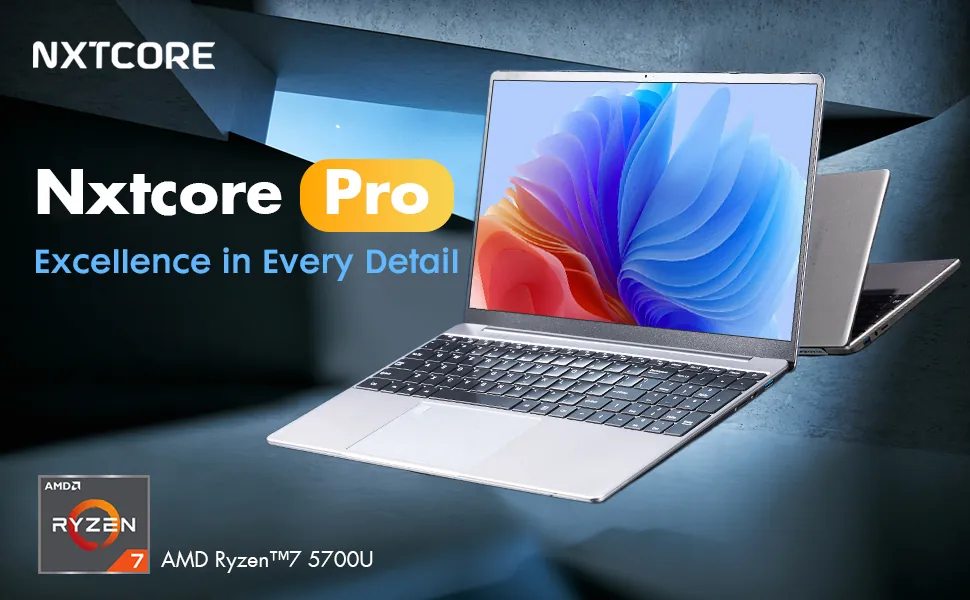
NXTCORE doesn't sell dedicated gaming rigs — the focus is affordable, versatile machines. If you want a portable laptop that handles daily work, streaming, and lighter gaming without a premium price, explore the NXTCORE performance laptops, including the NXTCORE Pro 1165G7 ($549). For lighter everyday needs, browse the everyday laptops collection starting at the NXTCORE Flex S140N ($329). The full NXTCORE lineup spans $179 to $899, averaging about $396.
Frequently Asked Questions
Is a gaming laptop or desktop better in 2026?
It depends on your priorities. A desktop still leads on raw sustained performance and upgradeability, while a gaming laptop wins on portability and an all-in-one price. For most people who value flexibility, a laptop is the better overall pick.
Can a gaming laptop match a desktop's performance?
Not quite, but the gap is small. Published benchmarks generally show a desktop GPU running 15–20% faster than the same-tier laptop chip because of higher power limits. For 1080p and 1440p gaming, a modern laptop is more than capable.
Are gaming laptops upgradeable?
Only partially. Most gaming laptops let you upgrade the RAM and storage, but the GPU and CPU are soldered and cannot be replaced. Desktops remain the clear choice if long-term upgrades matter to you.
Does NXTCORE sell gaming laptops?
No. NXTCORE focuses on affordable everyday and performance laptops priced from $179 to $899. If you want a versatile machine for work, study, and lighter gaming, browse the performance laptops or everyday laptops collections.